More Good is Better
Chapter 8 of After the Spike: Population, Progress, and the Case for People
Chapter 8 of After the Spike confronts the population ethics of declining fertility.
Read it at SSRN: https://papers.ssrn.com/sol3/papers.cfm?abstract_id=7087958
Abstract: One consequence of depopulation is so quiet that it would be easy to skip past it without noticing. Many billions of lives that could be excellent and full of wellbeing and joy would never be lived. Would that silence be a peace to welcome or a loss to mourn? Questions about values—questions beyond the graphs and numbers—surface whenever someone asks about the long-term future of the human population. In this chapter we ask these questions, and invite the reader to consider the ethics of depopulation. We present arguments that the chance to live a good life counts for something. To affirm this benefit is to say that depopulation matters beyond what it means for the trajectory of the economy, for balancing a government’s budget, or for geopolitical power. The solvency of public pension programs is not the only thing at stake. Population is people.
More Good is Better
One consequence of depopulation is so quiet that it would be easy to skip past it without noticing. Many billions of lives that could be excellent and full of wellbeing and joy would never be lived.
Would that silence be a peace to welcome or a loss to mourn? Religious traditions have their points of view. The Quran asks Muslims, “How can you disbelieve in Allah—when you were lifeless and He gave you life?” This question suggests poetically that not yet existing is a missing-out similar to no longer being alive. The God of Abraham famously charged Eve and Adam to “be fertile and increase, fill the earth and master it,” implying that life—existence rather than nonexistence—was a good to be pursued. Thich Nhat Hanh, a Vietnamese Buddhist teacher, said, “The greatest miracle is to be alive.”
But it’s not only the religious who say that human life is valuable. For many secular humanists, the chance to be alive is the greatest good luck. The astronomer Carl Sagan, an agnostic, thought “we are rare and precious because we are alive.” Sagan, facing an early death from cancer, chose to be thankful for the goodness that he had: “Far better, it seems to me, in our vulnerability, is to look Death in the eye and to be grateful every day for the brief but magnificent opportunity that life provides.” And although some say that philosophy is learning to die, novelist Ursula K. Le Guin thought life was what mattered: “We don’t live in order to die, we live in order to live.”
What about bigger stakes than a single human life? Most thinkers— secular and religious alike—would agree that human extinction would be a tragedy. Something important would be lost if all of humanity were gone tomorrow. Something even greater would be lost if all life, human and not, were gone tomorrow. Wellbeing needs, well . . . being. This chapter asks: What does it matter if another person gets to be born to live a good life? What does it matter if they don’t? What does it matter if billions don’t? As we stack up consequences for parents, for the environment, for technological progress and living standards, should we also give some consideration—not everything, not zero, some consideration—to the would-be people who would exist if the population stabilizes and not if it declines? Or should we care only about the wellbeing of people here and now?
Questions about values—questions beyond the graphs and numbers—surface whenever someone asks about the long-term future of the human population. Climate scholars and activists raise them. Our university colleagues raise them. The readers of our op-ed raised them. They can’t be settled by presentations of statistical facts. But they can’t be avoided in any honest and complete assessment of stabilization versus depopulation.
Nor can we leave unexplained our position in this book, which is: Yes, population size matters, and yes, progress toward a better future matters, and no, that does not motivate or justify pushing people into having children they don’t want.
So in this chapter we ask these questions, and invite you to consider the ethics of depopulation. Our belief is that the chance to live a good life counts for something. To affirm this benefit is to say that depopulation matters beyond what it means for the trajectory of the economy, for balancing a government’s budget, or for geopolitical power. The solvency of public pension programs is not the only thing at stake. Population is people.
Our piece of a big question
There are many ways to reach the understanding that it is a good thing when a good life is lived. It is possible to feel it. It is possible to reason to it, stepping through logic and details that arrive at this conclusion. A niche research subfield of economics and philosophy called “population ethics” does exactly that. This chapter introduces only as much population ethics as we need to compare depopulation against stabilization. It doesn’t aim to settle everything, nor to survey everything that any expert has ever written. Seeing this is big enough:
- More Good is Better. It’s better if there is more good in the world, other things being equal, and worse if there is less. That includes good lives: It’s better if there are more good lives.
“More Good is Better” may sound like a meaningless truism, but if a good life is a good thing, then it has teeth. It says we shouldn’t care only about the quality of lives, but also how many people get to enjoy them. This idea affirms that if we could wave a magic wand and add one more good life to the future, and if we could do so without costing anyone else anything important, then adding that life is better than choosing not to. It would make the world a better place overall. And so, if one possible future would contain more good lives, with their good experiences, then that counts as one benefit of that possible future.
When we write “better,” we are talking about the wellbeing of everyone. The idea of making the future better, overall and impartially— not merely better for you and your friends—has many names and flavors. When we write “better,” we mean what the U.S. Constitution calls “the general welfare.” We mean what economists call “social welfare,” what philosophers of ethics study when they do “axiology,” what the heroes mean when they talk about “the greater good,” and what the villains pretend to mean when they invoke the same phrase. We mean the kind of overall betterness that health or environmental economists in government agencies ask about when they weigh gains to some (say, the health benefits of removing lead from water service lines) against losses to others (somebody’s tax rate and somebody else’s inconvenience of having streets temporarily torn up) and assess what is overall better.
We believe that the general welfare matters and that everyone should care which future would be impartially better. That is not the same as believing that betterness or social welfare is the only thing that matters for any policy or social question. The same U.S. Constitution that seeks to promote the general welfare also lists rights and rules that the government is not allowed to disregard. Anyone who agrees that the general welfare is among the things that matter for society’s biggest policy and social decisions can agree with what we say in this chapter—that More Good is Better.
When we write “good lives,” we mean “good lives overall, on net.” We know that there are many ways to have a valuable, good life, so we are not being prescriptive about what a good life means. All sorts of experiences, bodies, traditions, or capabilities could be part of somebody’s good life. Some people would say that a life is good if the person whose life it is says so. Others would insist that a good life needs certain resources, or depends on the situation, or has to be great to count as “good.” It’s okay that everybody doesn’t agree about what a good life is. What matters for what we have to say here is merely that there is such a thing as a good life. We say that it would be better, all else equal, if the future held more of whatever good lives are.
As we go through this chapter, we’ll start from several commonsense notions. First, we hold this truth to be self-evident: Impartiality is ethically right. Impartiality means that a future in which some person named Abe is doing great, someone else named Bhimrao is doing well, and a third person, Chen, is struggling is every bit as good or bad as a future in which Chen is doing great, Abe is doing well, and Bhimrao is struggling. If asking about the general welfare means anything, it means being evenhanded.
Some cynics say that nothing matters. They say that even though some future or another may be better for them, there’s no such thing as a future that is better or worse overall when it comes to population—or climate, equity, freedom, security, or anything else someone else might value. We won’t entertain this cynical view.
We’ll also dismiss a subtler nihilism. It worries that—even if we can say what’s better or worse when it comes to some unchanged set of people—there is no meaningful better or worse about futures in which different lives are lived. It’s hard enough to judge, someone might say, when a policy has winners and losers among people here now. But population change? Two futures with different numbers of different people—one in which Carlos and Debbie are born generations from now and another in which Erica, Francisco, and Gautam are born generations from now? Some would say that we can’t judge, that nothing is better.
We disagree. Why? Because every social or policy question that matters is about futures in which different people are born and different lives are lived. That fact doesn’t make judging what might be better among possible futures some impenetrable puzzle. All of us make such judgments all the time. Every big shift in our societies (civil rights, no-fault divorce, Medicaid, electric lights) has had some impact on what people have chosen for their family lives—and therefore on which people later came to exist.
So we can judge, for example, that improving educational access for girls (and everyone else) in developing countries over the past century was good. Saying that improving education was good is a judgment that compares scenarios with different sets of people in them. That is because a whole generation of better-educated girls grew into women with different outlooks, different family-planning goals, and different childbearing patterns. And so different children were born at different times and in different numbers, compared to some alternative history in which educational access had not improved. Nearly all of us understand the statement “improving educational access for girls in developing countries was good” as both sensible and correct, even though it compares scenarios with different numbers of different people in them. We don’t stop asking which futures would be better just because to be a different future is to be a different set of people.
We have set the pieces on our board: There are such things as good lives. Some futures would be better than others and some futures would be worse. Every consequential policy or social change affects which people later come to be born. And when we ask which futures would be better, we must answer impartially. Now we are ready to face the question that this chapter is for, whether More Good is Better.
A blank space
Imagine a photo of a large group of people. You’re in it, too. It could be your family, if you’re the type that gets together for extended family gatherings. Maybe for you, the photo is a group of friends on a camping trip or at a bachelorette party or on a sports team. Maybe you don’t have to imagine. Maybe you have this photo propped on a shelf or saved in your phone.
Now imagine that half of the people in the photo with you never existed. They wouldn’t die because they never lived. You couldn’t miss them, in particular, because you never met them. You would be part of a different team, a different family, a different class, a different group of friends. There would be a different photo, but those missing people wouldn’t be in it. They wouldn’t be anywhere. Would that be worse? What if it were not only your group that was cut by half, but the whole world? Would the universe be a little less bright for the billions it was missing?
Humanity’s numbers might decline or stabilize. In this book, you have seen the graphs that chart these possibilities. Here is what is hard to appreciate, what’s hard to really, deeply feel from a figure on a page or a number like 8.2 billion: The numbers aren’t just numbers. They are people. What’s missing in the blank space following the downslope of the Spike is people who someday could be as real as you are, with experiences and aspirations and joys and sorrows that matter just as much as yours do.
The problem with a blank space is that people don’t see it. Here are three comments that readers posted when we published our article about the Spike:
- “I was alive in the early 1970s when the world population was half as much as it is now. I don’t recall thinking we had too few people then.”
- “World population in 1955 was ≈2.5B people. Today around 8B. I wasn’t alive in 1955, but, from what I read of that time and hear from those who were, it was a pretty nice time to be alive, no ‘shortage’ of people.”
- “I remember a planet with less than half as many people and it was wonderful. I loved every day, especially when I could be away from people (and this was much easier). If I wanted a job as a young person, I just walked into a business, filled out an application, and had a job. Getting into college, I had many choices and I do not remember it being at all stressful.”
We understand why these readers thought so. But there’s a blind spot hiding here. Perhaps these readers were imagining or remembering some of history’s more privileged lives, among those that were lived in the twentieth century.
Let’s look at 1955. World life expectancy at birth was only fifty years. One in five babies died before turning five. Angioplasty to clear blocked arteries, combination chemotherapy to treat cancer, and synthetic insulin to treat diabetes were not yet available. So people lost loved ones when today they don’t have to. In the United States, neither civil rights nor the gender revolution had yet made the progress toward a freer and more equitable society that would come over the following decades. In India, life expectancy at birth was in the thirties in 1955. The Dalit movement to reject the caste system by converting to Buddhism would not start for another year. In China, the Great Leap Forward was just about to commence and kill tens of millions. In 1955, most of Africa was still colonized and would not be decolonized for years. Many lives in 1955 were not what many readers, accustomed to the standards of seven decades later, would call “pretty nice.”
Not seeing the whole history is a common blind spot. It is not the ethical blind spot that this chapter is about, but noticing it might help to notice another one, a hidden premise that all three comments have in common. It is a privilege that all three readers share.
The commenters are alive. So they write from the point of view of somebody who is alive. (Good for them! Future people should be so lucky!) The population of 1955 was about one-third as large as today’s. Among you (the reader) and the two of us authors, only one of us might be here in a world the size of 1955.
It’s not a failure if someone does not immediately notice their ethical blind spots, and especially not this blind spot. To the contrary, it’s normal. Everybody reading this exists, so we all share that perspective and that privilege. It’s understandable not to notice the underlying assumption that the future billions who only might come to exist do not count.
But what if they did count—these future people who may or may not someday exist, depending on what we do, you do, and everyone else does? If we evaluate depopulation only from the point of view of people who already are alive—if we hide the assumption that we get to exist—then we ignore the question that this chapter is here to answer: Does it count as a benefit of stabilization that more good lives get to be lived?
Without any representative of the future to complain, it’s tempting to ignore or dismiss this question. But this temptation may be wrong. Future people can’t speak for themselves. If they have a stake that counts, then it’s up to us to hear their case and consider their cause.
Two hypothetical futures: Which would be better?
Do the additional lives that would get to be lived count as a benefit of stabilizing the population? To make progress and say anything concrete, we’re going to have to be more precise and start smaller. Doing so will let us build up to answering a common question: Shouldn’t we care only about the quality of lives lived and not their quantity?
To start simple, we’re going to ask only about adding good lives, magically without making any other changes and magically without any risk of the added lives being bad. This is our version of a way that the philosopher John Broome found to clarify the question. In the real world, adding lives does have other effects, including on other people. In the real world, some lives have been bad. Both of those real complications matter. And we’ve just spent several chapters thinking through some of the biggest real-world complications. But we’ve got to set aside those details for long enough to see whether there is any value in good lives at all, under any circumstances.
Here are the two simplified possibilities (they are also in figure 8.1, where each dot is a person, and dots higher on the page are better lives):
Figure 8.1. Which future would be better, A or B?
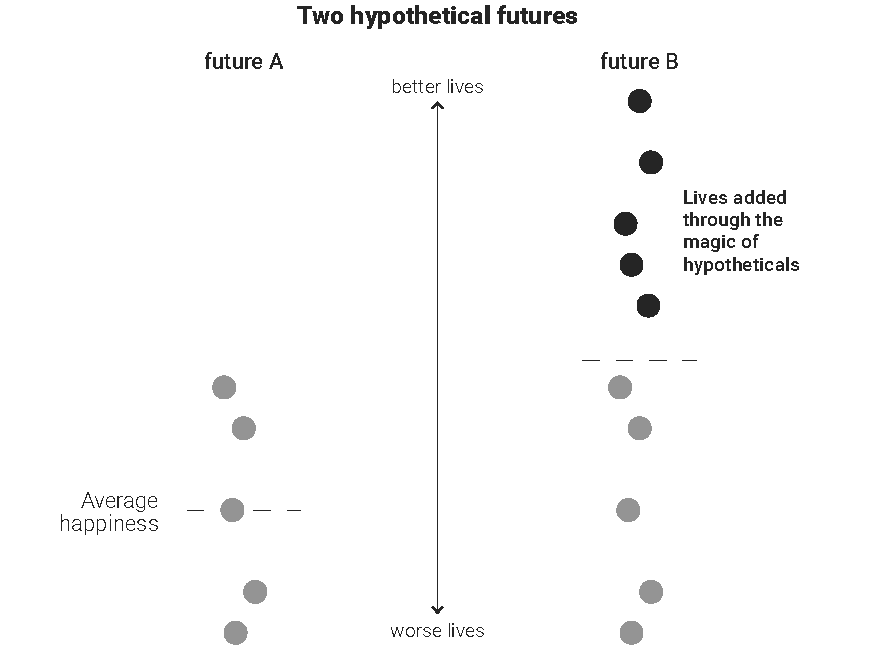
- Future A is whatever the status quo is, low birth rates and all. Your life, our lives, and the life of everybody you know about is in Future A.
- Future B is built in two magical steps. First, make an exact copy of Future A. That will be half of Future B, with one identical life for every life in Future A. Second, make the other half of Future B wonderful. Each person in this other half is living a wonderfully good life, better than the life of anyone you know about, and better than any life in Future A.
Every person and every life in Future A is also in Future B with the same wellbeing, the same ups and downs. But the additional lives in Future B are superbly wonderful and joyful. In other words, Future B is Future A plus an equal number of even-happier lives.
Built from these instructions, Future A and Future B turn out to differ in two ways: in their size and in their quality of life. Future B has twice as many people as Future A. And Future B has better lives in it, because half of the people are better off than anyone in Future A and the other half are just as well-off. One way of thinking about this is that the average life is better in Future B than the average life in Future A. But it’s not just the statistical average that’s better in Future B. The best life is better in Future B. The median (middle) life is better in Future B, too.
What about inequality? There’s no single correct way to measure inequality, but we made Future B so that it matches Future A in having the same Gini Index, one of the standard measures of inequality used by economists. What’s more, the worst-off person in Future B is no worse off than the worst-off person in Future A.
The question is, which future would be better overall? Because none of the lives that are lived in Future B but not in Future A are anything but excellent, and because nobody is made worse off if Future B happens instead of Future A, we say the choice is easy. Future B would be better than Future A. We find it hard to argue otherwise earnestly.
Perhaps someone would be tempted to say that Future B is worse because it hides some bad consequences for others. But the example is constructed so nothing else is helped or harmed by the existence of the extra people in B. There’s no environmental destruction, for example, from choosing Future B. The thought experiment ensures that nobody has to parent babies they don’t want to parent in order to get Future B’s larger population. It’s magic—useful, clarifying magic—that lets us separate the question of this chapter from the issues we’ve seen in previous chapters.
Perhaps someone else would be tempted to say that someone low on the wellbeing scale in Future B (someone toward the bottom of the chart who exists in both A and B) is harmed because now they have to suffer the unpleasantness or envy of sharing a society with people so much better off than them. But the construction of the example has ruled this out, too. We aren’t saying merely that, for the overlapping people who exist in either A or B, incomes or job satisfaction or family lives are held equal across A and B. We’re saying, for the people who exist in both, their wellbeing is held equal. Perhaps they aren’t the envious types. Or perhaps in Future B they get an extra scoop of ice cream to make up for the occasional painful awareness of the existence of people so much happier than them. Or perhaps they aren’t aware because the really great lives in Future B happen later, rather than contemporaneously with the bottom half of lives, or on a different planet. You can construct the example in whatever way you choose to keep the thought experiment tidy. And as a magically tidy construction, Future B is the better option.
Comparing stabilization against depopulation isn’t as tidy as comparing Future B against Future A. For one, we’ve sketched an idyllic future where none of the added lives are bad. But of course, suffering matters, too. More Good is Better is an if-then claim: If a life would, on net, be good, then it makes things better. So in the real world, we would need to take suffering into account, too. More bad would be worse.
And yet, we have learned something important by stripping away complications. Adding extra, wonderful lives and changing nothing else makes a future better. Leaving those lives out makes the future worse. If Future B is better than Future A (we say it is), and if the extra lives are the only difference (they are; we set it up that way), then Future B is better because of the extra, very good lives. More Good is Better.
But wait! Future B is better merely because the lives are better!
Here is an objection that we often hear: “No: Future B is better because lives in it are better, not because there are more of them! The wellbeing of the typical person is higher in Future B, for example, because the added good lives pull up the overall profile. It’s about the quality of lives, their quantity doesn’t matter at all.”
Here’s the most straightforward version of an only-quality-not-quantity view, though there are others: We could try to judge how good or bad different futures would be only by the average wellbeing that people would have. How happy are people on average? How well are their material, social, intellectual, spiritual needs and aspirations met, on average? In principle, a smaller population could have better lives, on average, or the other way around. The only-quality-not-quantity approach tells us that if we knew about average wellbeing, then we could ignore how many lives were lived.
Our view, that More Good is Better, says that quantity and quality both matter—that we can’t ignore how many lives get to be lived. Why do we think that caring only about quality misses something crucial? In part, because following its logic leads to some pretty strange places, and to conclusions we cannot endorse.
If the only-quality-not-quantity proposal is right, then adding good lives doesn’t necessarily make things better, even if they would be splendid lives. That’s because—according to the only-quality-not-quantity position—adding new lives makes things better only if those lives would bring up the average.
- Why only-quality fails: Contrary to the only-quality view, adding lives cannot make things worse as long as the added people’s lives are good (in an imaginary scenario with no consequences for any other people).
It is not for you or us to say that a good, worthwhile life, one that all in all brings happiness or value to its owner and harms no one else, is unworthy of existence. But the only-quality-not-quantity approach mistakenly disagrees. The only-quality-not-quantity position tells us that it would be better (not fine, not good enough, better) if some people never exist, even if they would love their lives.
Here’s why that’s wrong: Imagine a child born in Uttar Pradesh, maybe next year. This particular child is lucky. She is poor by your standards, but her family loves her. She manages to avoid serious illness. She is happy and healthy as a child and enjoys her siblings. She rides the tide of improving gender equity to a school she loves attending as an adolescent. She finds a way to a job she is proud of, maybe as a nurse. She still enjoys her siblings as an adult and calls them walking to and from work. Her parents give her say in her arranged marriage. It turns out to be a good match. She is friends with her sister-in-law. She enjoys becoming a parent. She’s healthier and wealthier and safer than most women who grew up in the same part of the world in decades and centuries past, even if she’s not as healthy and wealthy and safe as most people who read this book. In short, she grows up to live a life that is happy, if below average for 2025—a life that she wouldn’t trade for nonexistence, after thoughtful meditation on the question.
What if her wellbeing is below average, not only for 2025, but for all time? Did her life make things worse? According to only-quality-not-quantity, it would have been better if she had never existed. Not better for her or according to her. She decidedly wants her life! But the universe would have been better without her, this view would say, because her existence nudges down the average. This is one way to see that the only-quality-not-quantity approach goes wrong.
Let’s see that same point again by adding a life to the diagram we’ve been building. We will make this different from the example of the Uttar Pradeshi woman, by making the added life more splendid than any life so far lived. Now imagine, in figure 8.2:
Figure 8.2. Now which future would be better, B or C?
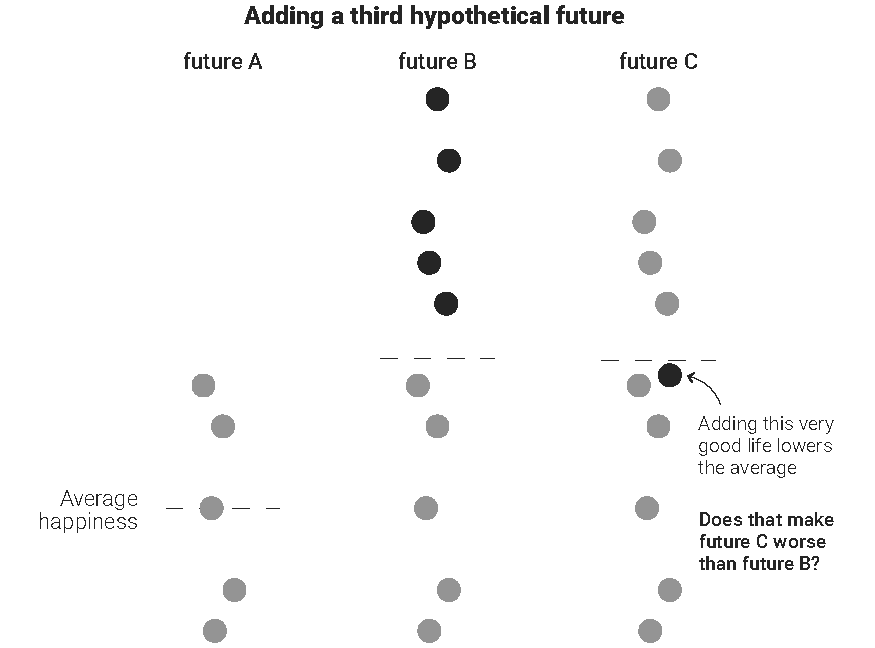
- Future C is just like Future B, but adds one more person. This person’s happy life is better than yours (the reader’s) and ours (the authors’). They love their life. It’s very good. Really it’s quite amazing by your standards. But, in this example, that one more very good life is not quite as good as the average life in the very excellent Future B.
Oops. Adding that extra happy life in Future C pulled down the sky-high average of Future B. So according to the only-quality-not-quantity view, Future C is worse than Future B. The only-quality-not-quantity approach is not merely indifferent to adding this good life. It instructs us that adding a good life would make things worse, in this case. It says this even though the person added to Future C would be happy to be alive. Even though nobody and nothing else is harmed.
How could adding a good, happy life—a life better than yours and better than any life ever lived so far in humanity’s long history—make things worse, if nobody else is harmed or affected at all? Our answer is that it can’t, so the only-quality-not-quantity view, even if it sometimes points in the right direction, must be wrong as an overall, infallible guide to what is good.
To be clear: It’s not that a person couldn’t think Future C is worse than Future B or isn’t allowed to because of some contradiction of formal logic. When we say “it’s wrong to rank Future B as better than Future C” or “it’s wrong that adding that very good life makes things worse,” we’re not saying that a robot couldn’t be programmed to disagree without frying its circuits. We mean that somebody who has thought through the implications shouldn’t disagree.
This is a possible person we are talking about here. They would live a very good life that they would be grateful for. Why should anyone say no? What reason to deny that person a life could they give (in this imaginary example with no costs or consequences for anyone or anything else)? What arguments would they present to the judge in some cosmic court? What would they tell this potential person’s lawyer or fairy godmother? So yes, it’s possible to think Future B is better than Future C, but we don’t think anyone should.
Focusing only on quality leads to the same set of problems however one defines quality. Instead of the average, what about deciding what would be best by comparing the median person’s wellbeing? Or the wellbeing of the worst-off person only, ignoring everyone else? Any only-quality-not-quantity formulation turns out to fail a basic test by recommending that some people with good, valuable lives make matters worse, just by existing.
Do you see that as a problem? We do. That’s one reason we say that the only-quality-not-quantity view is wrong. We began this section by considering the possibility that “it’s about the quality of lives, their quantity doesn’t matter at all.” But doing that would lead us to preferring that some great lives that had no negative impacts on anyone else would never happen. So we conclude that caring only for quality just can’t work as a tool or an indicator to judge whether depopulation would be better than stabilization.
We say both quality and quantity matter. That still leaves plenty of open questions. For example: How exactly should we weigh quality against quantity when there is a trade-off to make? That is a big question, but not one we need to answer in this book. As a practical matter of facts—facts about health, mortality, education, income, leisure time, security, and many other indicators—a bigger world has proven to be a better world (on average and by most other quality criteria that one might prefer). So, for the real-world choices that lie ahead of humanity, stabilization looks better than depopulation, whether we narrowly consider only quality or whether we say that More Good is Better, which means that both the quality and quantity of good lives count.
Who does Future B make a difference for?
There’s a story that helps us see that More Good is Better. You may have heard a version of it before, but it’s worth hearing again.
In the hour before dawn, walking along the beach after an overnight storm, you see someone picking up starfish and gently throwing them back into the ocean, where they can survive. Many starfish are stranded on the beach, as far as you can see in either direction.
“Why are you doing that?” you ask.
“This one’s still alive. It may live, if the offshore pull is strong enough. I can help them.”
“But there are too many!” you object. “You’ll never make a difference!”
The person stoops again and plops another star into the water. “It made a difference for that one.”
Loren Eiseley, an anthropologist at the University of Pennsylvania, wrote the first version of this story in the 1960s. Like Kangaroo Mother Care, the Pythagorean theorem, and other non-rival innovations, Eiseley’s story has thrived and its applications evolved. So the version that you might have heard could be a little different from the story Eiseley wrote in The Unexpected Universe.
Eiseley’s story captures an idea called “independence” by the economists who study social wellbeing. The lesson from the starfish story is that in an evaluation about which of two futures would be better (throw back a single starfish or don’t), you shouldn’t worry about what won’t change or be different across those two futures (the many others on the beach that will never be helped; the many more others in the ocean that don’t need help). You should think only about the differences between the two options. And if those differences are only good—if the consequences are good for everybody touched by a policy, by a charitable program, or by your actions—then, independently of anything else, that’s enough to know what would be better.
The extra lives in Future B and the added life in Future C have a lot of good in them. In particular, they are good experiences for the people who live those lives. These people would like their experiences. And that’s all. The mere existence of these added lives does not make matters worse or better for anybody else, in our simplified scenarios, so we don’t need to consider the unaffected people in our evaluation of what future is better. Evaluations like average wellbeing fail because their judgments are affected by unaffected people—or starfish.
Future C is better than Future B, which is better than Future A. More Good is Better, when all else is equal. We’ve seen this by considering magic examples where good lives just pop in. To keep going, we will have to turn off the magic. To grapple with the ethics of population, we need to consider both magical scenarios and real-world consequences.
Wouldn’t a kajillion lives be even better?
If an additional life would be good in a clean and simple thought experiment, does it mean ever more lives would always be better in the real world? Our answer here is pretty simple. No need to go through complicated scenarios or imagine a Future D. Believing that something is good just doesn’t mean the same thing as “It would always be better to have any imaginable amount more, whatever the costs and consequences.”
The one comment with the greatest number of recommendation upvotes at our New York Times article was this:
- By this logic, we should all be having as many kids as possible. Why stop at 2 kids, when I can theoretically have 25? Think of all the potential joyful lives I am suppressing by not having as many children as biologically possible.
Because so many readers agreed with this objection, we must take the blame for leaving the misunderstanding open. Of course it would be worse if everyone had twenty-five kids! It’s beyond our imagination exactly how it would wreck lives, society, and women’s health if the only thing that anybody ever tried to do was to parent another kid. It would be bad enough indeed if someone who absolutely didn’t want any children ended up with even one.
Even if a stabilized future would be better than a depopulated one, it doesn’t mean more babies are always better than fewer. It’s a mistake to confuse “something would be good” with “something would be the only good thing and should be our only goal to the exclusion of all other goals.” It’s good to feed hungry people; it’s good to teach children; it’s good to heal the sick. That’s all true, even though a dollar, a minute, a thought spent on one of those good goals is not spent on the others. None of these is the one and only thing we should do, to the exclusion of all other goals and values. Each of the last five chapters has considered something that matters.
It’s probably not a good idea to eat an entire pie. But it might sometimes be a good idea to eat one slice (unless you’re allergic, or happen to have no taste for pie). There’s no conflict here. The fact is, even if stabilization is better than depopulation, it doesn’t follow that a kajillion lives would be better than a few billion. (And what about beyond the facts? What if we again turn on the magic of far-flung hypotheticals? Could a kajillion lives ever be the best plan? That question goes beyond the practical question that this book is here to answer. But many scholars are captivated by it. If you’re interested in the philosophy of a hypothetically enormous population, then after the conclusion of this book, you’ll find a Repugnant Appendix.)
Stand for reproductive freedom, and care about a depopulating world, too
When we talk about values and the ethics of population change, one of the first questions is usually about reproductive freedom. If a world with more good lives would be better, the worry goes, then wouldn’t that justify forcing people to have children that they would rather not have? It might feel like there is a conflict between freedom and the idea that More Good is Better. Is standing for reproductive freedom compatible with caring about depopulation? Yes, these ideas are compatible. They are both part of making a better future.
The fact that something would have benefits or be better when people chose to do it does not imply it’s okay to force people to do it. Let’s start by stepping away from pregnancy in particular. Most of us can recognize that it would be valuable if you saved a life by donating one of your kidneys. That would make the world a lot better for somebody, and a little better overall. But recognizing this doesn’t mean that the law should compel you to part with your kidney. The philosopher Judith Jarvis Thomson first spelled out the moral analogy between other people’s kidney failure and reproductive freedom. For many obvious reasons, it makes both society as a whole and individual lives better when your body is yours, not someone else’s kidney farm.
We could really stop there, but we are keenly aware that when we propose that More Good is Better, someone might bristle in alarm. Wouldn’t agreeing to the idea that good experiences in good lives make the world a better place mean that all of us should drop everything to raise more children? Wouldn’t it mean that women would be obligated to conceive and birth babies they don’t want? No, because there is no actual conflict in believing both of the following two sentences:
- It would be better if the world did not depopulate.
- Nobody should be forced or required to have a baby (or not to have a baby).
Let’s see it through the lens of Seema’s work as a nurse in the KMC ward. One way to offer people the benefits of good, happy experiences, loving relationships, and fulfilling projects is to participate in the teamwork of creating their lives. Another way, what Seema does at work, is to participate in the teamwork of extending their lives, by saving them from dying in their very first days. Seema’s work does not create lives. But saving the lives of babies so close to birth does allow many whole (long) lifetimes of good experiences to happen that otherwise would not. Seema’s profession is her choice. But what if she wanted to leave the KMC ward to take a different job, or to marry and move to a different district, or to stop being a nurse for any other reason? Almost nobody would endorse using the government to compel Seema to stay at her post, continuing to save lives. The obvious truth that “the government should not try to force anyone to be a nurse” is perfectly compatible with the idea that “one way the world could be better, all else equal, is if through the efforts of nurses (and with society’s help), more babies survived to live a good life.”
In the same way, the obvious truth that “the government should not try to force anyone to be a parent” is perfectly compatible with the idea that “one way the world could be better, all else equal, is if through the efforts of parents (and with society’s help), more babies were conceived and born to live a good life.” Trying to force people’s big life decisions is an atrocious idea that has nothing to do with the proposition that avoiding depopulation would be valuable.
In the case of nurses and saving lives, it is easy to see this truth because governments, as a matter of standing policy, do not tend to force people into nursing (or any other profession) against their will. In the case of parents creating lives, alarm bells trigger because some governments do force women into bearing children against their will, to say nothing of forced sterilizations. But there is no inherent conflict here, either.
We can respect individual freedom not to be a nurse. And in the same way, we can respect the freedom not to be a mother, or a death row lawyer, or a kidney donor, or an aid worker in a war zone, or a volunteer at a suicide prevention hotline, and so on. And we can do it all while acknowledging that life is good. Of course we can!
If you agree that Seema is not required to be a nurse, then you should agree that nobody should be required to become a parent, merely because life is valuable and More Good is Better. The world is more complicated than that. The threat of coercive reproductive policy—as real and harmful as it is—does not refute the idea that More Good is Better, or even speak to it.
What we can learn from progress on matching kidney donors to patients
So then what does More Good is Better mean, in practice? What would it look like to care about the value of life as a society, while respecting individual choice about parenting?
What to do to avoid depopulation is the question for the next part of the book. For now, we will tell a story that offers a preview. It’s about the challenges of matching kidney donors to patients in need. Kidneys, we said a few pages back, make a powerful analogy for reproductive freedom. Most healthy people have two kidneys and could do fine with one. So kidney transplants often start from living people who donate a kidney to help a relative. Altruistic kidney donations do a lot of good. They save the lives of people who wouldn’t otherwise have access to dialysis (in poorer countries, not everybody does), and they improve the lives of people who do.
The trouble is that a transplant can only happen if a donor matches blood and tissue types with a patient. Donors tend to want to help the people they know and love—a parent, a sibling, a child—but family members may not be a match for each other. For a long time, doctors have understood that they could make more matches happen in pairs: One donor from family X wants to help a relative, but doesn’t match; another donor from family Y wants to help a relative, but doesn’t match. If the donors happen to line up across families, a two-by-two trade—family X giving a kidney to Y and family Y giving a kidney to X—could happen with four surgeries in one day. That’s an improvement, but it still leaves many people out. What are the chances that all four people in families X and Y are ready to go and the two families manage to find each other at that right moment?
That question is the kind that excites Alvin E. Roth. Roth is an economist who studies how people make matches in large groups. A job is a “match” between a worker and a firm. An accepted college admission is a “match” between a student and an institution. A romantic match is a “match.” And, a person donating a kidney to another who needs one and shares blood and tissue types is a match. In the 1990s, Roth helped the medical profession improve its tools to match doctors-in-training to medical residencies. When Roth heard about this problem in kidney donations, he realized his tools could help there, too.
Roth and his collaborators used what they had pioneered in the economics of matching to build a new system for kidney donations. First that meant building up databases and processes to help families like X and Y find each other more easily for a two-family swap. Later it meant devising new algorithms that could identify and propose longer chains of donors and recipients. In long chains, your spouse might get a kidney while your spare kidney goes to someone else’s mom (with whom you match). Her son would give his spare kidney to someone else (with whom he matches). And so on. Often these chains of dozens of unrelated people could get going because of one “non-directed” donor—someone who didn’t have a sick relative and so wasn’t asking for a kidney to come back to their recipient, in return.
U.S. medical institutions adopted Roth’s system. Family members with a mismatched blood type could finally help their loved ones. The waiting time for a kidney fell. Thousands more transplants happened. Lives were extended and improved. Roth won a Nobel Prize in 2012. This increase in transplants created more good, and it made things better.
The moral of this story is not that we expect economists to solve parenting by designing a better tool to match parents to babysitters or romantic partners to one another. The point is that within the bounds of free, voluntary choice, there is often room to make things go better. Before Roth’s system, kidney donation was voluntary. After Roth’s system, kidney donation was voluntary. Before Roth’s system, prospects were worse for people with kidney disease. After Roth’s system, prospects were better.
It is unimaginative and untrue to think that respecting free choice means everyone is stuck with whatever happens to be the status quo. What Al Roth and many doctors, nurses, and organ donors have proven is that a smart and compassionate rethink at a systemic level can make for a better future—can even add more life to the world—without overriding anyone’s self-determination or bodily autonomy. That’s not a plan for avoiding depopulation, but it is inspiration. We told you at the beginning of this book that what needs to happen now is to start a conversation about depopulation on humanity’s horizon. Chances are, an hour of reading and thinking is not enough to spark an epiphany about the value in getting to experience a good life for someone distant in time and place. That’s okay. This chapter isn’t meant to settle the issue. It’s an invitation to engage with it. That’s hard work. It can’t happen all at once.
Being impartial—caring about people far beyond our immediate circle—is hard. And not only for grand questions of the future of humanity. A grounded analogy might be helpful here. Local housing politics often turns on partiality: How much weight should one give to the voices and demands of current residents?
Mike’s wife, April, tries to think more broadly in her job in Austin’s planning department. She encourages her department and the city’s elected representatives to consider not just current Austinites, but also people who only might get to join the Austin community, depending in part on what she and her colleagues manage to accomplish.
April tries to keep in mind how different development plans could be a boon to the people who would come to live in Austin, if only more housing were available. They could live closer to their jobs instead of fighting traffic each day to commute and pollute from far-flung suburbs. That’s not an easy position to hold: New housing and denser neighborhoods often dissatisfy incumbents—people lucky enough to be here now and have their voices heard. Potential Austinites don’t get to show up at the community feedback meetings. Still, April wants to consider their wellbeing, too.
- Potential Austinites count. “Better” and “worse” can’t only mean better and worse for the people who already live in Austin. “Better” means for everyone.
- Potential humans count, too. “Better” and “worse” can’t only mean better and worse for the people who are already here or who will be born no matter what else happens. “Better” means for everyone.
Even though More Good is Better isn’t the one right idea that settles everything (no one right idea is), doesn’t the fact that one future would contain more good than another count for something? And if— if—together we might find ways to support aspirations for parenting and caregiving that turn the future away from depopulation, without harming one another or sacrificing anything important, then wouldn’t that be better? Maybe a lot better?
End Notes
We intend More Good is Better to be a basic principle of population ethics that many can agree with. More Good is Better doesn’t specify a full approach to population ethics. In particular, it says nothing about what to do when all else isn’t equal. It is consistent with many views in population ethics.
To agree that More Good is Better, one need not accept the particular arguments that we presented for it in chapter 8. But these arguments touch on some of the cornerstones of the population ethics literature. Here are those cornerstones:
Impartiality. We assume that the general welfare is impartial, treating everybody evenhandedly.
Pareto. We assume that it makes things better, overall, to make anybody’s life better, if nobody else is harmed.
Completeness. Between any two possible futures, one would be better than the other, unless they are both exactly as good. This is what we mean when we say that it makes sense to compare two futures, even if they don’t have the exact same set of people in them. Philosophers debate this one, but economists almost always accept it. The real world has never been one unchanging set of people. If a changing population means that you can’t say what’s better or worse, then you couldn’t say that climate change or casteism is bad and girls’ education in India is good. Our argument here builds upon the Depletion argument of Derek Parfit and the Greedy Neutrality argument of John Broome.
Independence. This is the principle of Loren Eiseley’s starfish rescuer: In asking which of two possible futures would be better, you only need to consider the people who are affected. The people for whom it doesn’t make a difference don’t influence which outcome would be better. There are two important arguments in favor of Independence.
Our discussion of Independence builds upon one of the most powerful arguments in population ethics: Jefferson McMahan’s Stone Age argument, which Derek Parfit writes about as the Egyptology objection and economists know as Independence of the Utilities of the Dead. Whether it would be better to add a life cannot depend upon unknown facts about long-dead people in the Stone Age (or in the distant future, outside of our ability to control, or otherwise somewhere unaffected). That’s enough for Independence, once you’ve accepted Impartiality.
The other powerful argument for Independence emerges from considering risk and uncertainty. All important policy and social decisions indeed involve risk and uncertainty. A long tradition of research in decision-making shows that the only plausible way to say which risky prospects are better ends up to be by taking expectations, which sharply narrows the theoretical possibilities toward Independence. In research with Johan Gustafsson and Stéphane Zuber, Dean has shown how variable-population Independence emerges from John Harsanyi’s framework for social decision-making under risk (building upon Broome and Marc Fleurbaey).
Continuity. We didn’t actually argue for this in chapter 8. It’s a technical principle that says that tiny enough differences in people’s wellbeing can’t make large differences in our overall evaluations of which futures would be better or worse. A tiny enough consequence for one person is not more important than countervailing consequences for many, many people.
This is an important list: Impartiality, Pareto, Completeness, Independence, and Continuity. Together, they imply that welfare economics or axiology has to have an additive form, meaning that the way to assess whether one future would be better than another is to add up some transformed value for each person’s wellbeing. In symbols, ∑i f (wi), where wi is the wellbeing of person number i and f is some increasing transformation that turns wellbeing levels into numbers that can be added. Blackorby, Bossert, and Donaldson proved, in a formal theorem, that these principles imply this formula. The logic of the theorem is that Independence says that unaffected people cancel out; terms that cancel, in a formula, are a short step from addition. If somebody wants to reject the impartial adding-up approach, they will have to reject one of these five principles.
The theorem specifies that the general welfare is additive, but it does not say what form the “some transformed value” (that is, f ) takes. The transformation could oppose inequality in a way known as “prioritarianism,” although that is controversial. Separately, it could take a different controversial stance with what is known as a “critical level.” So there are details left to fill in, even if one accepts these five principles. But, however these details are settled, this impartial adding-up approach fits readily with economists’ familiar practices in evaluating programs and policies. And it coheres with our claim that More Good is Better.
Broome J. 2004. Weighing Lives. Oxford. (Figure 8.1 and Figure 8.2 are the authors’ illustrations, inspired by Broome.)
Thomson JJ. 1971. A defense of abortion. Philosophy and Public Affairs. (Hat tip to Mark Budolfson and Richard Chappell. Tyler Cowen makes a similar point in Stubborn Attachments.)
Roth AE, et al. 2007. Efficient kidney exchange: Coincidence of wants in markets with compatibility-based preferences. American Economic Review.
†Blackorby C, et al. 2005. Population Issues in Social Choice Theory, Welfare Economics, and Ethics. Cambridge. (The adding-up formula is characterized in Theorem 6.10, assuming an ordering of populations as finite-length vectors of interpersonally comparable lifetime wellbeings that can be represented with the order and topology of the real numbers.)
† McMahan J. 1981. Problems of population theory. Ethics.
† Parfit D. 1984. Reasons and Persons. Oxford. (Depletion §123, Egyptology §143.)
† Broome J. 2005. Should we value population? Journal of Political Philosophy.
† Gorman WM. 1968. Conditions for additive separability. Econometrica.
† Adhami M, et al. 2024. Population and welfare: The greatest good for the greatest number. NBER.
† Gustafsson J. 2024. The need for merely possible people. JESP. (Gustafsson shows the self-defeating logical trouble one runs into by trying to maintain that the interests of future people matter, but the interests of possible yet non-actual future people do not.)
† Relevant to Future B adding only top-quality lives, see the inequality-sensitive criterion in: Asheim GB, Zuber S. 2014. Escaping the repugnant conclusion: Rank‐discounted utilitarianism with variable population. Theoretical Economics.
More diffusely, this chapter and note is based on Dean’s background research in collaboration with Mark Budolfson, Stéphane Zuber, Johan Gustafsson, Orri Stefánsson, Christian Tarsney, and Harvey Lederman, most of which amounts to commentary on Theorem 6.10, and on:
† Tarsney C, Geruso M, Spears D. 2023. Egyptians, Aliens, and Okies: Against the sum of averages. Utilitas.
† Spears D. 2020. Matt Yglesias has a plan for one billion Americans. His prescriptions may not be radical enough. thewire.in.